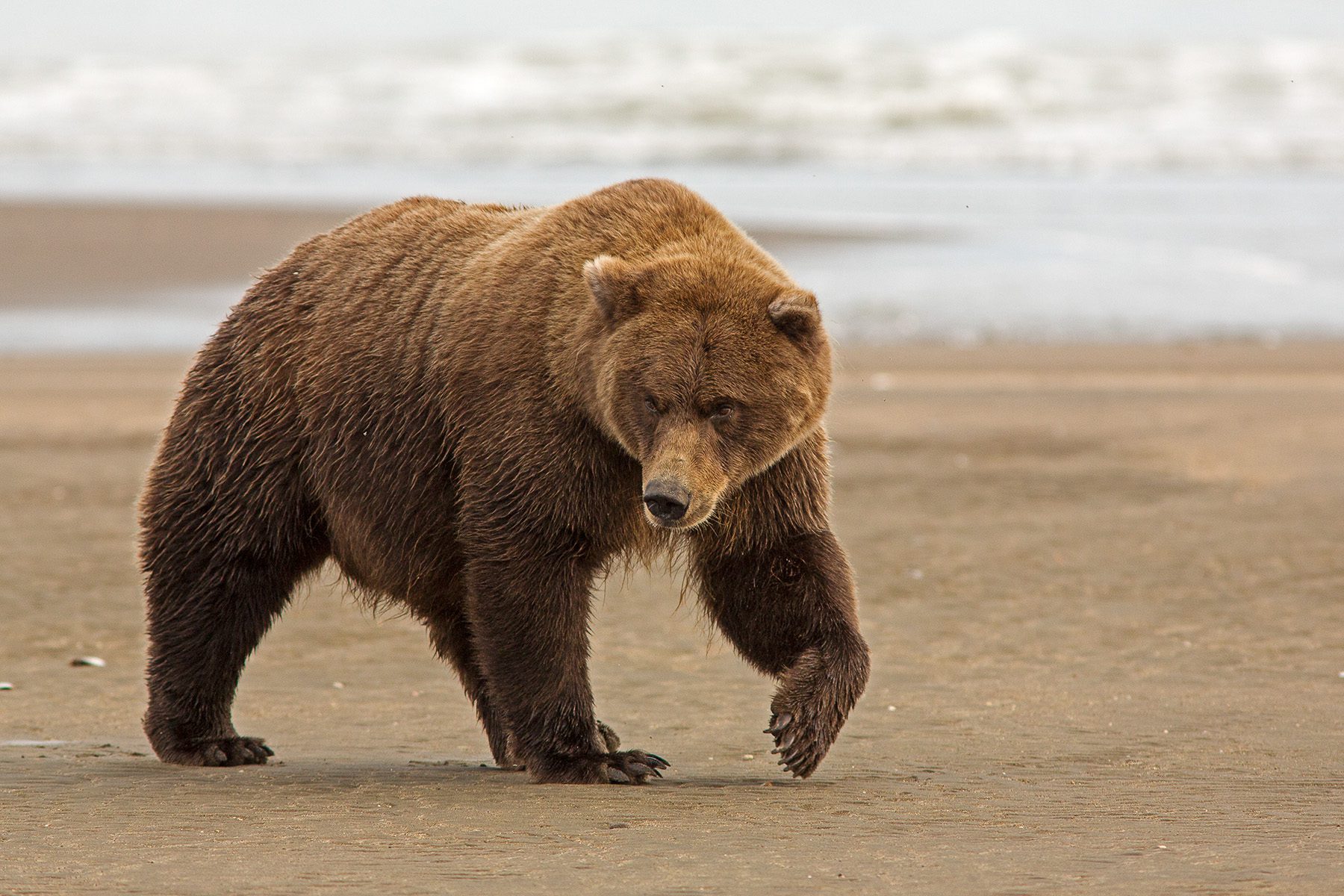
The Alaska Department of Fish and Game is offering surplus brown bear permits for nonresident hunters in Game Management Unit 22 on the Seward Peninsula and the Norton Sound region.
The new permits were announced last week after too few nonresident hunters applied during the regular November-December draw period. When there are more permits than applicants, the Alaska Department of Fish and Game can reopen them as “undersubscribed” permits on a first, come first serve basis later in the season.
Alaska Department of Game Nome Area Management Biologist, Sara Henslee, said that has become routine in the region over roughly the last decade.
“This is something that happens pretty much every year,” Henslee said. “We just don't have enough interest with nonresidents applying given the limited numbers of non resident guides in the area and the kind of difficulty and access to get to a lot of these hunting areas.”
The department has 15 undersubscribed brown bear permits for nonresident hunters across Unit 22.
Nonresidents must use a registered guide or, if a US citizen, be accompanied by a first or second degree relative who is at least 19 years old. Henslee said there are limited guides registered in Unit 22, and even fewer who focus on brown bears. For permit DB685, which covers subunits 22B and 22C north of Nome, access is especially challenging and Henslee said only a few guides operate there, especially with one recently retiring.
“I think there's just not a lot of interest right now and availability from those guides to handle more clients than they already are, but I guess we'll kind of see how things shake out if there's new guides that move in with this vacancy that opened,” Henslee said.

Henslee says nonresident hunters make up 40% of the brown bear harvested in Unit 22, most of that occurring in unit 22A under a general season permit for nonresidents. The remaining 60% are taken by residents, whose general-season permits are not limited by a drawing.

A 2021 National Park Service survey found brown bear populations were relatively stable on the Seward Peninsula from 2015 to 2021, with an estimated 17 bears per 1,000 square kilometers during that period.
Henslee said annual harvests have hovered around 100 brown bears a year across Unit 22 since the late 90’s, but harvest levels vary across subunits. She said Unit 22C which surrounds Nome, typically sees more hunting volume than Units 22B, east of the Darby mountains, and 22D and 22E, north of Nome.
“When we get above that [100 harvest] number, we kind of start to wonder, like, is that harvesting too much? And with a lot of our harvest coming out of managing unit 22C, something we wondered is if maybe we're over-harvesting bears in that area when there's a really good winter, really good snow machine access, and hunters can really get after it.”
To help track and manage that pressure, the department set a brown bear quota of 25 bears in Unit 22C, shared by residents with the registration permit RB670 and nonresidents with the drawing permit DB685. Henslee said the 25 bear quota wasn't met last year, but biologists are reviewing it to ensure it's a sustainable limit.
Currently, 10 undersubscribed DB685 permits are available in Units 22B and 22C and five DB690 permits in Units 22D and 22E.
Surplus nonresident bull moose permits are also open in Unit 22B, east of the Darby mountains. Three DM845 permits remain available.
To apply for a permit, visit the ADF&G website.
UPDATE: This article was updated with nonresident and resident harvest percentages across Unit 22. (3/17)
UPDATE: The first quote in this article was changed. (3/17)
UPDATE: This article was updated for clarity. (3/17)


