In the 1960's, members of the King Island community were forced to abandon their home in the Bering Sea, leaving behind not only a place, but a way of life. Now, hand-carved tools and hunting gear from that era are returning to Nome as part of a new collection donated to the Carrie M. McLain Memorial Museum.
The pieces include a large seal skin hunting bag and an ice fishing jig with a rare baleen line. It’s complete with an ivory hook dotted with red beads to attract fish.
“I would say this is very old, something that was passed down in the family. The pieces of baleen are tied together in a special way, that's amazing,” the museum’s Director, Cheryl Thompson, explained.
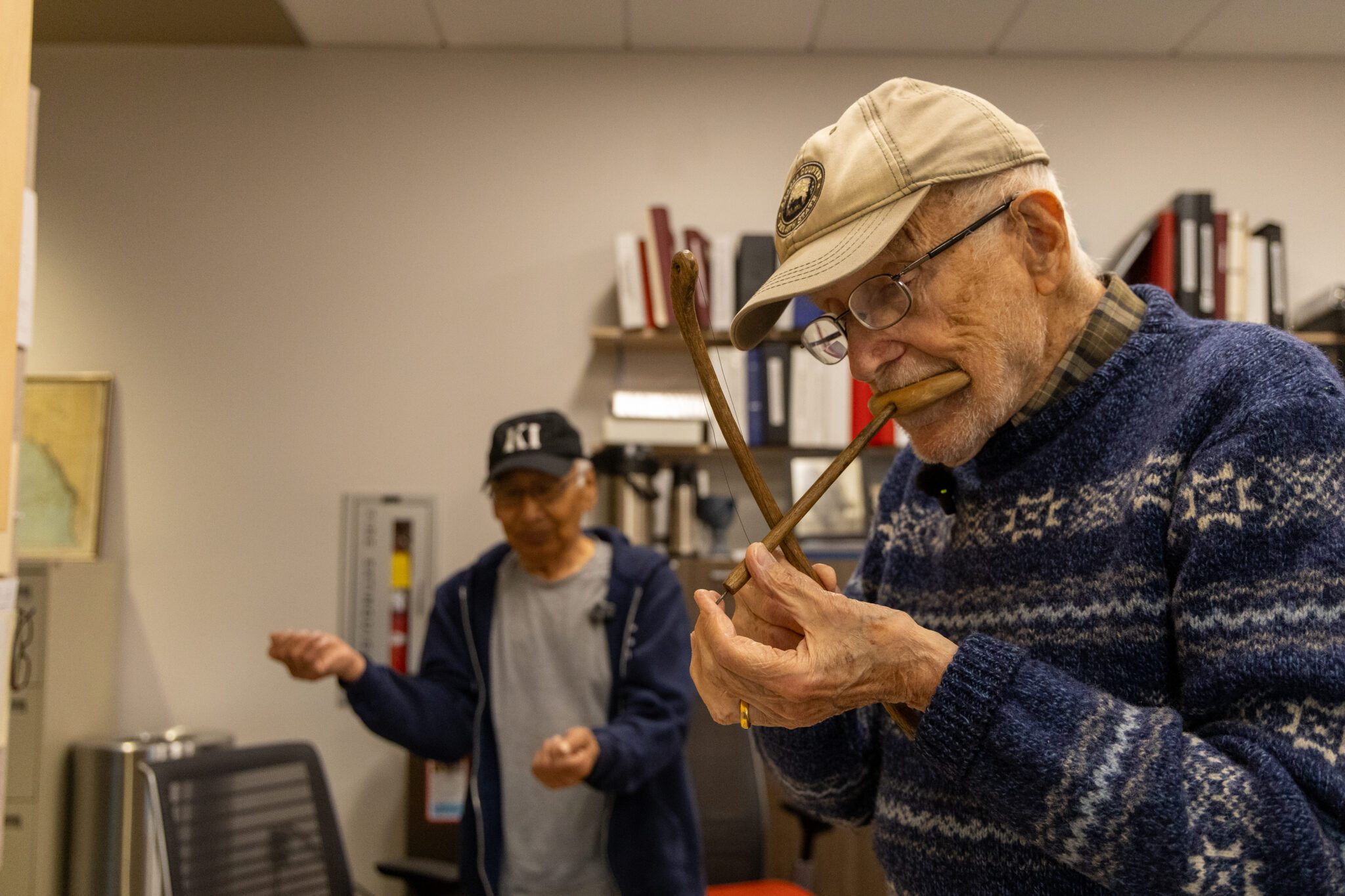
Among the donations are an ivory bow drill and seal skin rope handcrafted by King Islander Aloysius Pikonganna in the 1960’s. The former owner of the items, Larry Rockhill, worked as a guidance counselor at Chemawa Indian School in Oregon. He said he first met Pikonganna while visiting Nome on a school trip.

“Aloysius Pikonganna wasn't just anybody. He was the name as far as King Island goes, as a master carver and a leader of the King Islanders,” Rockhill said.
Rockhill said Pikonganna took him under his wing, whisking him away to communities across the Seward Peninsula. But it was at King Island’s new home – later destroyed by a storm in 1974 – that Rockhill saw King Island craftsmanship up close.
“King Island East End was definitely where it was all happening, and the ivory carving was going on in this old Quonset hut,” Rockhill recalled. “The ivory carvers were sitting, as they do, on the floor, back straight with maybe their anvil and their files and other homemade tools doing their work.”
He jumped at the chance to buy some pieces to take back to campus.
“I wanted to be able to have some things that were truly part of the Inupiat Eskimo culture that I could bring back to Chemawa, and that students would feel that this was part of their home environment,” Rockhill said.
Rockhill went on to teach Native Studies. Along with some items from Utqiagvik, Gambell and Savoonga, he used the pieces to demonstrate the ingenuity of Alaska Native people.
“They were doing it for 1000's of years without any of the things that the white man can't live without. So these have been exposed, and I hope, have made some sort of an impression over several 100 students over those years,” Rockhill said.

While working at Chemawa, Rockhill befriended King Islander Raymond Paniataaq.
“I was in high school, in boarding school in Chemawa at that time. I don't know how we met, but we became real good friends,” Paniataaq recalled.
“Yeah, we just hit it off,” Rockhill said.
Rockhill said over half a century later, it's like no time has passed between the two.
“It's just been one of the highlights of my life to sit up til midnight and share old experiences,” Rockhill said. “Raymond is my teacher. He's the one that I can only learn from about the values and the way of life of the King Islanders and the Inupiat Eskimo people. I treasure that immensely.”
Now, Rockhill said it was time to bring the pieces back home.

“Because of my somewhat advanced age, 87, my wife and I both said it's time for them to be repatriated, to be going back home to where they came from,” Rockhill said. “So this is really a gift to the King Islanders.”
The pieces were carefully packed up and flown back to Nome. Paniataaq said he was excited when he got the news.
“I knew large part of our history was coming back, and lot of our artifacts tend to go out to different museums, and they never come back. These are back,” Paniataaq said.
The pieces will be unveiled to the public Tuesday night at 7:00 p.m. at the Carrie M. McLain Memorial Museum. Elders are invited to share their memories of the artifacts.


