
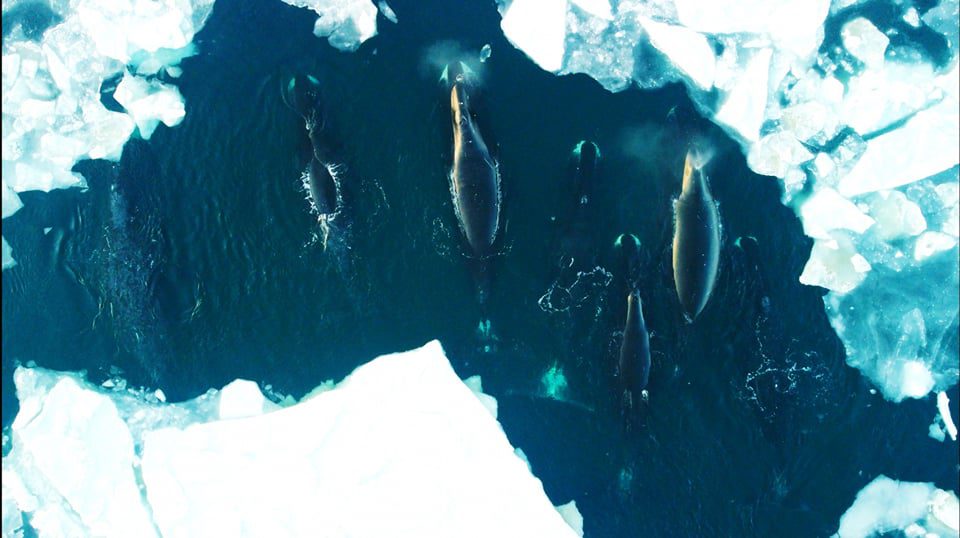
- New paper links bowhead whale feces to climate change in the Beaufort Sea
- More than 200 bowhead whales harvested for subsistence purposes were collaboratively sampled over 18 years
- Study is a partnership with the Alaska Eskimo Whaling Commission and a team of international researchers
A new study released in the science journal Nature suggests there’s a direct link between warming waters and the rise of harmful algal bloom events in northern waters. Scientists have theorized this relationship for many years, but needed a way to prove it. The multinational research team found the answer somewhere surprising.
From a small office tucked in the University of Alaska Fairbanks Northwest Campus, Gay Sheffield pointed toward a graph updated just that morning. It showed sea surface temperatures near Nome over the course of 40 years, with a dark blue line for 2025 consistently outpacing annual averages.
It's part of a worrying trend across the Arctic, which is warming at a faster rate than the global average.
Sheffield has studied marine mammals for nearly four decades. It's taken her to coastal communities across northern and western Alaska. For over 20 years she worked with the North Slope Borough Department of Wildlife Management’s Bowhead Whale Health Assessment Program at Kaktovik sampling bowhead whales harvested for subsistence purposes. One of the many health monitoring objectives was to monitor for the presence and amount of harmful algal toxins in bowhead whale feces.

Sheffield said bowhead whale are like cattle, constantly grazing the ocean and consuming patches of tiny zooplankton like krill.
“They don't have any fancy gulp, they just sieve the water,” Sheffield explained. “Constantly feeding quietly. And those krill are full of algae that the krill eat.”
For the most part, the ocean is full of good algae thats the base of marine ecosystems. But there are also bad algae, which can produce harmful neurotoxins like saxitoxin or domoic acid. Saxitoxin can cause potentially fatal human illnesses such as paralytic shellfish poisoning (PSP). Five people have died from the illness in Alaska, though no human cases of PSP have been reporting from the northern Bering, Chukchi, or Beaufort seas.
Although saxitoxin is a natural part of the ecosystem, it’s becoming a growing concern in Alaska. The reason for that boils down to ocean temperatures. Algae, like other photosynthetic organisms, rely on sunlight, carbon dioxide, and just the right mix of other ocean conditions to survive. But the harmful algae Alexandrium grows with warmer-waters.
Climate Link

Rick Thoman, a Climate Specialist with the Alaska Center for Climate Assessment and Preparedness, said one species of concern, Alexandrium catenella, thrives at ocean temperatures around 46 degrees fahrenheit.
“Once you get ocean temperatures up to that, then things can get going. And as the temperatures get warmer than that, then the rate that these Alexandrium are growing increases very rapidly,” Thoman said.
Thoman is a co-author of the paper and helped chart the sudden uptick in sea surface temperatures across the northern Bering, Chukchi and Beaufort seas. His work revealed that almost all of the top ten hottest years on record came since the turn of the century.
“That's no surprise to folks that live in the region, and that is being driven in large part by the loss of sea ice,” Thoman said. “Let’s say the first two thirds of the 20th century, ice dominated both seas in most seasons. Not every season, but most seasons.”
Partnerships
Data used in the new paper was first collected for a partnership between the North Slope Borough’s Department of Wildlife Management and Alaska Eskimo Whaling Commission. The team examined 205 samples, harvested for subsistence purposes by Alaska Natives in the Beaufort Sea.
The paper’s lead researcher, Kathi Lefebvre, said the samples offered a window back in time.
“They're feeding on krill and copepods, those organisms are feeding on the toxic algae and accumulating the toxins,” Lefebvre said. “This is a real food web sample from a top consumer in the same way over two decades. They’re basically a bio-sampler.”

The sampling was just part of routine health assessments — but as harmful algal blooms became more frequent, the climate link started to become more and more clear. In 2022, the Bering Sea was home to the largest and most toxic harmful algal bloom event nationwide.
“The 2022 bloom provided a lot of validation for why we should do this. Let's really look at what we can see and see if we can find this relationship, to be able to share it and know what's happening and understand the mechanisms,” Lefebvre said.
Every year they ran the study, the researchers found the same thing: the vast majority of whales had detectable amounts of saxitoxin in their feces. The low amount of toxins are not believed to be harming the bowhead whales themselves, but their growing presence in the food web could eventually pose a risk to other marine wildlife — and to human health.
The study was funded as part of a five-year project through the National Centers for Coastal Ocean Science called ECOHAB. Collaborators from around the world were assembled to complete the study. Sheffield said it truly was a team effort, including the bowhead whales.
“Actually, the whale is telling us something here. And that’s through their relationship with the whaling community. There's not one person that could have pulled this study off. It took everyone working together,” Sheffield said.
According to the Japan Aerospace Exploration Agency, this June’s sea ice extent was tied with 2020 for the lowest on record. It’s causing concerns for another potentially widespread harmful algal bloom event. Sheffield said if you see an animal acting unusual or lethargic, report it to Kawerak’s Subsistence Program (Chuck Menadelook; 907 443-4265), NSHC Office of Environmental Health (Austin Ahmasuk; 907 434-0227) or UAF Alaska Sea Grant (Gay Sheffield; 907 434-1149)


