

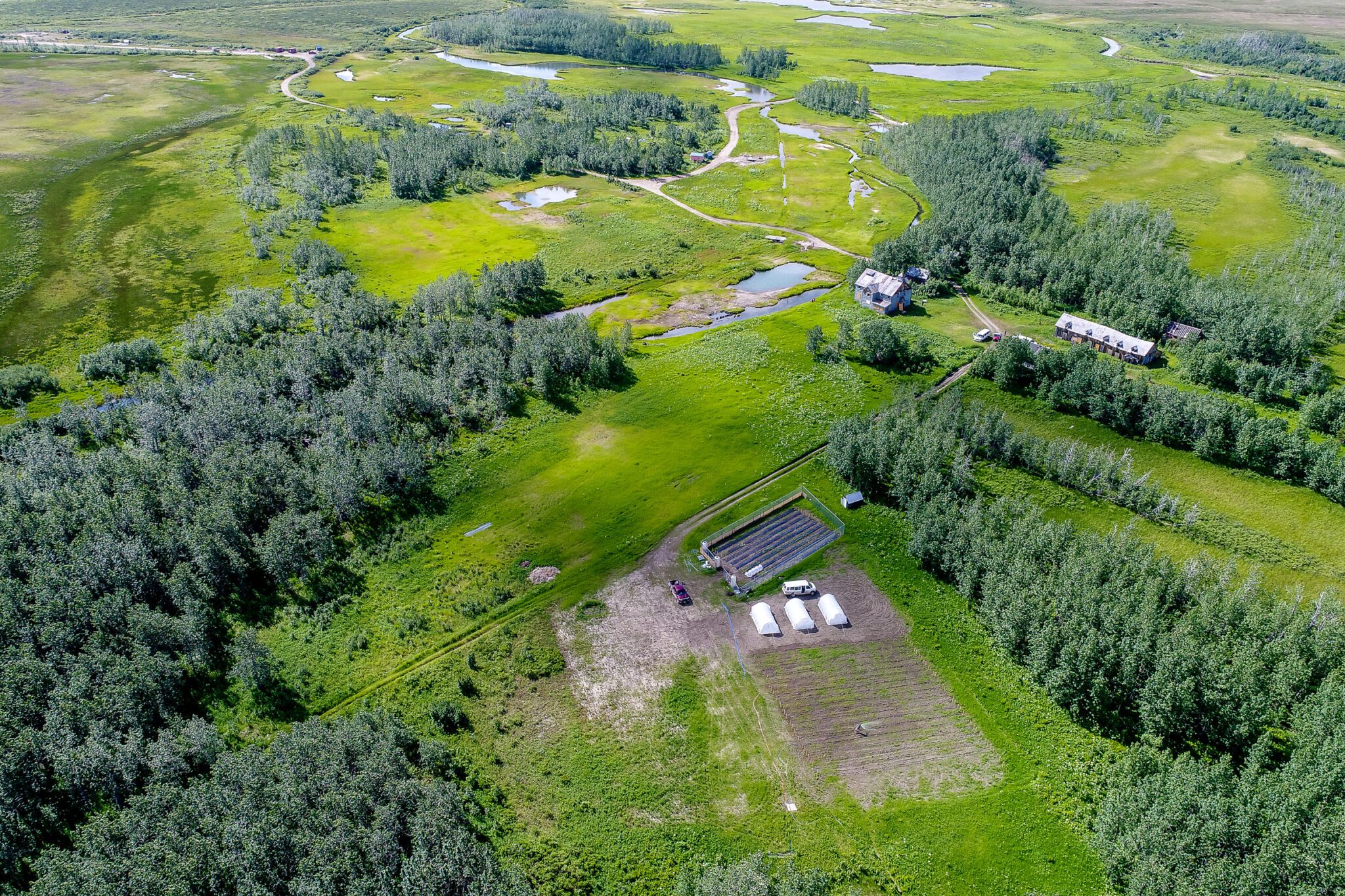
There are many reasons Unaatuq, commonly known as Pilgrim Hot Springs, has historically been a gathering place. There’s rare hot pools in the arctic climate, red salmon running up the river, and the land, warmed by geothermal activity, is farmable.
This summer, Pilgrim Hot Springs is growing with increased farm development to broader food distribution and more community workshops.
Callan Christensen, the new agriculture manager for Pilgrim, has a long list of produce the team has started for the garden, including a variety of vegetables from broccoli and cauliflower to potatoes and bopak choy.
But Christensen said plant starts aren’t the only thing underway at the farm 60 miles north of Nome. Over the past few weeks, he’s been hard at work tilling soil, ordering fencing and starting fruit trees.
The goal, he said, is to boost the sub-arctic farm’s production.

“The plan is to hopefully fence in a larger area of that main field and grow more food,” Christensen said.
But the farm’s ambitions — literally — go much deeper. Christensen hopes to foster healthy soil at the Pilgrim farm, in order to maintain growth of healthy produce for years to come.
“Healthy soil can do incredible things. If you have mycorrhizal fungi and you have the bacteria and you have the worms, and believe it or not, voles can even be helpful to help turn soil and aerate it and oxygenate it,” Christensen said. “A living soil is a regenerative soil, and a regenerative community. If you eat that food, it's healthy, it's good for you.”
Pilgrim leans into local partnerships to get their healthy produce to those who need it. Recently, Christensen met with Norton Sound Health Corporation’s CAMP Department and Nome Community Center to learn about local programs promoting healthy eating and supporting those in need of fresh produce.
“We have an incredible resource: arable land on the Seward Peninsula. And so we want to see that food go to the people who need it most,” he said.
Christensen said Pilgrim is also partnering with the Rural Alaska Community Action Program (RuralCAP) for a USDA grant that supports food growth projects in rural Alaska. With this funding, Pilgrim plans to develop a so-called “food forest”, an area with levels of cultivated growth, including trees, berry bushes and ground cover.
“It’ll be a permaculture space, a space that kind of doesn't require much tending. We want it to be kind of a blend of Native foods and non-Native foods,” Christensen said. “A place where people can come and participate in workshops.”
Pilgrim’s General Manager, Kelsey Gallaher, said Pilgrim Hot Springs has workshops planned throughout the summer on indigenous plants, insects and bees and mushroom foraging. She said bringing the community to the Pilgrim site is a valuable opportunity to share the work and activities they have going on.
“It’s really nice when we can involve the community, bring them out and show them what we've been doing,” Gallaher said. “There's so much going on behind the scenes at Pilgrim that… it's hard to wrap your mind around everything going on out there.”
Gallaher and Christensen agreed that their top priority is honoring the history and cultural significance of Pilgrim Hot Springs, along with sharing the farm’s abundant resources with the people of the region.
“Part of what we're trying to do is take care of the land so that it's in good shape and continues to be a resource that provides for the people for generations,” Christensen said.
A common question the team at Pilgrim fields is the status of an access road connecting the Nome-Taylor Highway or Kougarok Road to the remote site. Gallaher said this year Pilgrim has its own dozer to work the road.
“We're working on getting it in good shape,” she said.
Pilgrim Hot Springs opens for the summer season on Tuesday, June 25, with a mini fest planned with local music for June 28. If you’re interested in seeing produce from Pilgrim Hot Springs in your community, reach out to Callan Christensen at cchristensen@kawerak.org.


